About
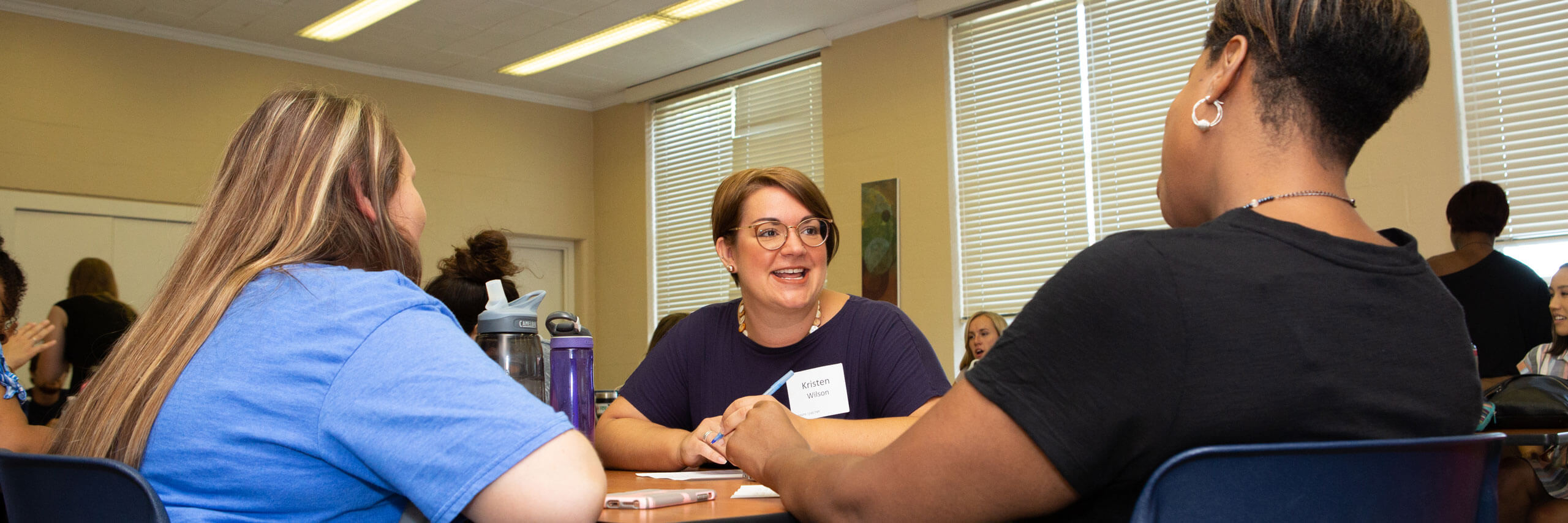
The School of Social Work offers a high-quality education focused on you. We know you have big things to accomplish, and all our faculty and staff are here to support you. As an emerging social work professional, you will feel more like a colleague in our program.
-
Stop By
Find us in Rachel Cooper
-
Contact Us
-
Mailing Address
School of Social Work
Illinois State UniversityCampus Box 4650
Normal, IL 61790-4650
School of Social Work Mission, Vision, Values
-
Mission Statement
The mission of the School of Social Work is to further social and economic justice, progressive social change, human dignity and personal freedom in a pluralistic society undergoing rapid technological and social change. To this end, the School strives to provide leadership in undergraduate, graduate and continuing education, applied research, and both academic and community service with support from public and private partnerships.
The School of Social Work advances the mission of the University and the social work profession through an undergraduate and graduate education program with a particular commitment to outreach to the poor, the disenfranchised, and the vulnerable.
-
Philosophy
Within the guiding spirit of our mission statement, the philosophy of the School of Social Work at Illinois State University is as follows:
- We believe that faculty, administration, staff, and students must share a common and well-articulated view of the future of our School and that it is the responsibility of all to work toward this vision. A core component of this vision is academic freedom.
- We believe that our School must be committed to excellence in research, teaching, and service to the community, and that it is the task of all faculty, students, and administration to continually refine the measures of effectiveness of our research, teaching, and service.
- We believe that the role of our faculty is to teach, to expand the boundaries of research, and to apply knowledge through community service to local, national, and international problems and issues in a manner that is consistent with our School's vision.
- We believe that the role of the administration of our School is to lead us in defining and setting up management structures that address our School's needs; and to acquire and manage the resources necessary to move toward accomplishing our School's goals.
- We believe in participatory decision-making; that is, all faculty, administration, and students have the right to participate and the responsibility to seek and promote informed participation in School decisions. Input from students and the practice community will be sought on specific matters.
- We believe in open communication.
- We believe faculty and administration alike should be accountable and that performance should be linked with the reward systems of the University.
- We believe that School decisions should be debated and formed within the framework of the governance structure.
- We believe that all faculty members should be given adequate resources to conduct research, to teach, to do community service, and to promote their professional development.
-
Land acknowledgment for Illinois State University
Illinois State University was built on the land of multiple native nations. These lands were the traditional birthright of Indigenous people who were forcibly removed and have faced centuries of struggle for survival and identity in the wake of dispossession and displacement. We would like to acknowledge that our campus sits on the lands that were once home to the Illini, Peoria and the Myaamia, and later due to colonial encroachment and displacement to the Fox, Potawatomi, Sauk, Shawnee, Winnebago, Ioway, Mascouten, Piankashaw, Wea, and Kickapoo Nations. We also express honor to those Indigenous people who we may have excluded in this acknowledgement due to erasure and historical inaccuracy.
Thanks to the members of the ISU Native American Studies program, the Department of History, the Department of Sociology, Women's, Gender, and Sexuality Studies: and the Multicultural Center for sharing their land acknowledgment statements, which were used to develop this statement. This statement and page will continue to evolve.
-
Anti-Racism Statement
The School of Social Work acts persistently and impatiently, to defy racism, anti-blackness, and systems of oppression in our community. Our goal is to work toward equity, justice, and belonging. We will act collaboratively, working with students, faculty, staff, alumni, University, and community members to train, educate, and empower individuals to dismantle patterns of racism and injustice. We will act strategically to identify and challenge systems that perpetuate racism, while building systems that support equity.
The Illinois State University School of Social Work has worked diligently to respond to concerns about racism, anti-blackness, and other forms of marginalization against Black, Indigenous, People of Color (BIPOC) members in society, on our campus, and within our School. Events such as the Anti-Black student rally have prompted this initiative towards a more inclusive campus. The Anti-Racism Committee was established to help address these issues and builds on a core social work competency of engaging diversity and difference in practice. The Anti-Racism Committee builds on the School of Social Work’s mission to further social and economic justice, progressive social change, human dignity, and personal freedom in a pluralistic society undergoing rapid technological and social change.
The Anti-Racism Committee will help our students, faculty, and staff learn and thrive in racially equitable, liberating, and empowering educational spaces. We will bring awareness about approaches to eradicating racism, anti-blackness, and systems of oppression at Illinois State University, in Bloomington-Normal, and beyond. The School of Social Work will collaborate with leaders and organizations to bring social change and human dignity for all.
-
History of the School of Social Work
The first social work faculty at ISU were hired in 1968 by the Department of Sociology and Anthropology as part of the continuing national movement toward social work professionalization. In 1970, the Board of Regents recommended that ISU develop an undergraduate social work program to meet the growing need for entry-level professionals. In 1976, the social work major was implemented, and new faculty positions added, bringing the total number of social work faculty to six.
The undergraduate social work program continued to grow within the Department of Sociology, Anthropology, and Social Work, and soon became the largest in the state at that time. In 1979, additional tenure lines were created, and faculty were hired. In 1980, the undergraduate social work program received its initial accreditation from the Council on Social Work Education (CSWE), retroactive to 1979. We have been continuously accredited since that time. In 1992, the social work program became independent of Sociology and Anthropology and became the Department of Social Work. In 1998, the Illinois Board of Higher Education approved our proposal for a Master of Social Work degree program at Illinois State University. In August 2000, the first class of MSW degree candidates began their graduate study at ISU. In September 2000, the Department of Social Work became the Illinois State University School of Social Work. In 2002, the first ISU MSW students received their degrees and in 2003, the MSW program received initial accreditation from CSWE.
The School of Social Work is committed to high standards of scholarship; community, school, and University service; and teaching. We take great pride in the quality, diversity, and experience of our faculty. Several of our faculty members are recognized nationally and internationally as leaders in their areas of expertise. Many publish books and articles in professional journals and present papers at professional meetings and conferences. Some serve on the editorial boards of major journals. Others hold positions on the boards of professional and academic associations and councils. Many serve as consultants to local, state, and national agencies and are involved in professional and community service, apart from their teaching, academic service, and scholarly work.